
Sept 8, 2026
A speaker crossover capacitor helps filter audio signals and directs different frequencies to the appropriate speaker drivers. Its capacitance value can directly affect the crossover characteristics.
Audio capacitor tolerance is the allowable difference between the actual capacitance and the rated value.
For example, a 10 μF capacitor with ±5% tolerance can have an actual capacitance of 9.5–10.5 μF.
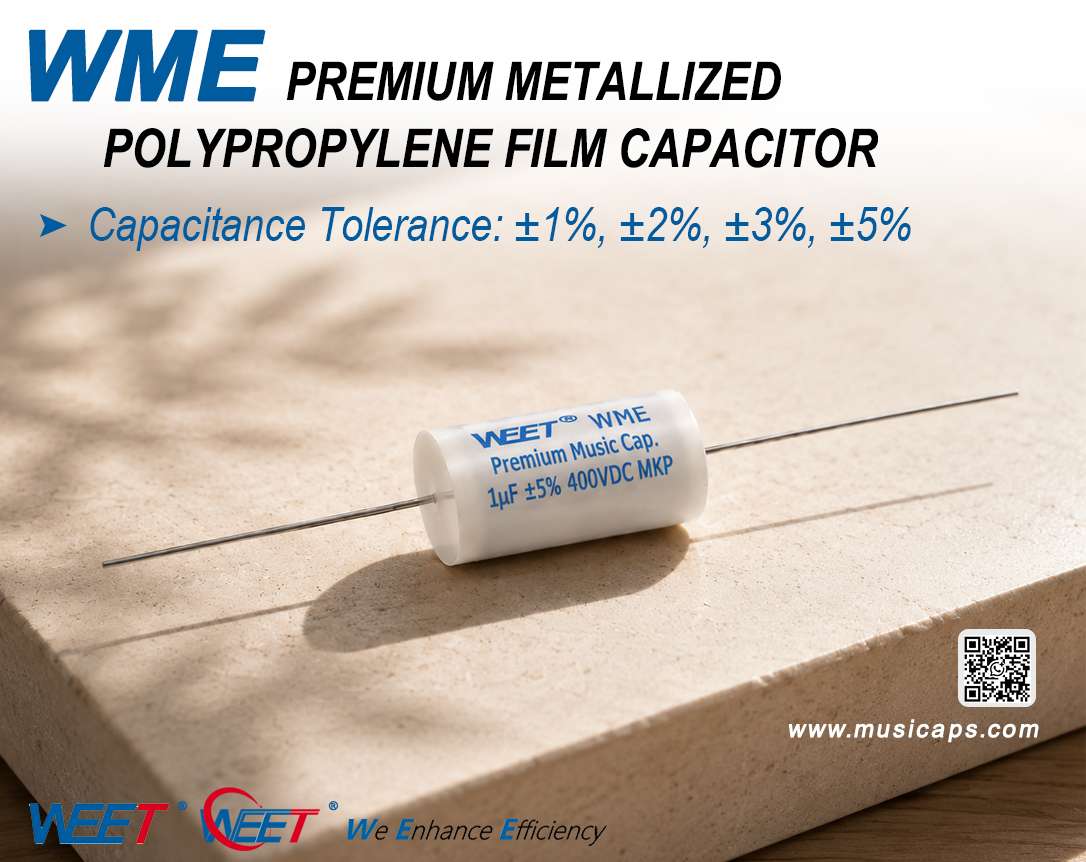
WEET WME speaker crossover capacitor tolerances include ±1%, ±2%, ±3%, and ±5%.
For a speaker crossover capacitor, tighter tolerance means more consistent capacitance. This helps provide more predictable crossover characteristics.
The right tolerance depends on the crossover design and application requirements. ±1% or ±2% may be suitable for precision applications, while ±3% or ±5% can be sufficient for general applications.
The right capacitance tolerance depends on your speaker crossover design and application requirements.
±1% - For high-precision audio applications
±2% - For applications requiring good capacitance consistency
±3% - For general audio applications
±5% - For standard applications and cost-sensitive designs
The WEET WME Speaker Crossover Capacitor is designed for speaker crossover networks and other audio applications requiring consistent capacitance.
Looking for a speaker crossover capacitor with specific capacitance or tolerance requirements? Contact WEET for more information.
Want to learn where WME can be used? Click here to read the article: How To Choose WME Film Capacitor For Audio Applications?
Contact: Wallis Tao
Phone: + 86 13925700687
E-mail: sales@weetcapacitor.com
Add: Qing Hu Village, Qishi Town, Dongguan City, Guangdong